Beginner-Friendly Home Workouts for Women (No Equipment)
A complete, evidence-backed guide with warm-ups, 40+ exercises, 12-week progressive plan, nutrition basics, troubleshooting, and printable checklists. By VitalWell Hub. Download Slim & Strong (App)
Overview — Who this guide is for & why home, no-equipment workouts work
This guide is written for women who want a practical, safe, and effective way to start exercising at home without any equipment. It is designed for absolute beginners, women returning after a break, and anyone with limited time or access to gym facilities.
Why bodyweight home workouts? Bodyweight training is accessible, low-cost, and scalable. Research and public health guidelines show that regular physical activity — including muscle-strengthening activities — improves cardiovascular health, metabolic health, mental wellbeing, and daily function. When programmed with progressive overload (increasing challenge over time), no-equipment routines reliably produce meaningful results for strength, endurance, and mobility.
Safety & medical considerations
Pre-exercise screening
Before beginning any new exercise program, consider a brief health check:
- If you have known cardiovascular disease, uncontrolled hypertension, diabetes with complications, or recent major surgery — talk to your clinician.
- If you experience chest pain, unexplained shortness of breath at rest, fainting, or dizziness, stop and seek medical help.
- Pregnant or postpartum? Get tailored advice from your healthcare provider before starting or modifying exercise intensity.
General safety rules
- Prioritize technique over repetitions. Good form reduces injury risk and improves results.
- Start with shorter sessions and build consistency before increasing volume or intensity.
- Use pain as a guide: sharp joint pain or severe discomfort = stop and reassess.
How to use this guide & session structure
The content is divided into clear sections so you can read top-level guidance or deep-dive into specifics. Each workout and exercise includes:
- Purpose: what the move trains
- Form cues: step-by-step mechanics
- Levels: Level 1 (absolute beginner), Level 2 (beginner), Level 3 (progressing)
- Progressions & regressions: how to make the move easier or harder
Session template (simple):
- Warm-up: 5–8 minutes of dynamic movement
- Main session: 10–40 minutes (pick according to time & goal)
- Cool-down: 3–8 minutes gentle stretching / breathing
Warm-up and cool-down routines (exact sequences)
Why warm-up matters
A proper warm-up raises body temperature, increases blood flow to working muscles, primes the nervous system, and improves joint mobility. It reduces injury risk and helps you perform better.
5–8 minute dynamic warm-up (do before every workout)
- Marching or light jogging in place — 60 seconds. Eyes forward, pump arms slightly.
- Arm circles + shoulder rolls — 30 seconds each direction.
- Hip circles — 30 seconds each direction.
- Leg swings (front-to-back) — 10 each leg. Hold a wall for balance if needed.
- Bodyweight squat to reach — 8–12 slow reps. Sit back into hips, reach forward at top.
- Walking lunges (or stationary lunges) — 6–8 each side.
Cool-down (3–8 minutes)
Finish with gentle walking or marching for 1–2 minutes, then 20–30 second static stretches for major muscles: hamstrings, quadriceps, calves, chest, shoulders, hip flexors. Finish with deep diaphragmatic breathing for relaxation.
Comprehensive exercise library — 40+ no-equipment moves
Below you'll find detailed instructions for each exercise. Use regressions if an exercise feels too hard, and use progressions when it becomes easy. Always prioritize control and alignment.
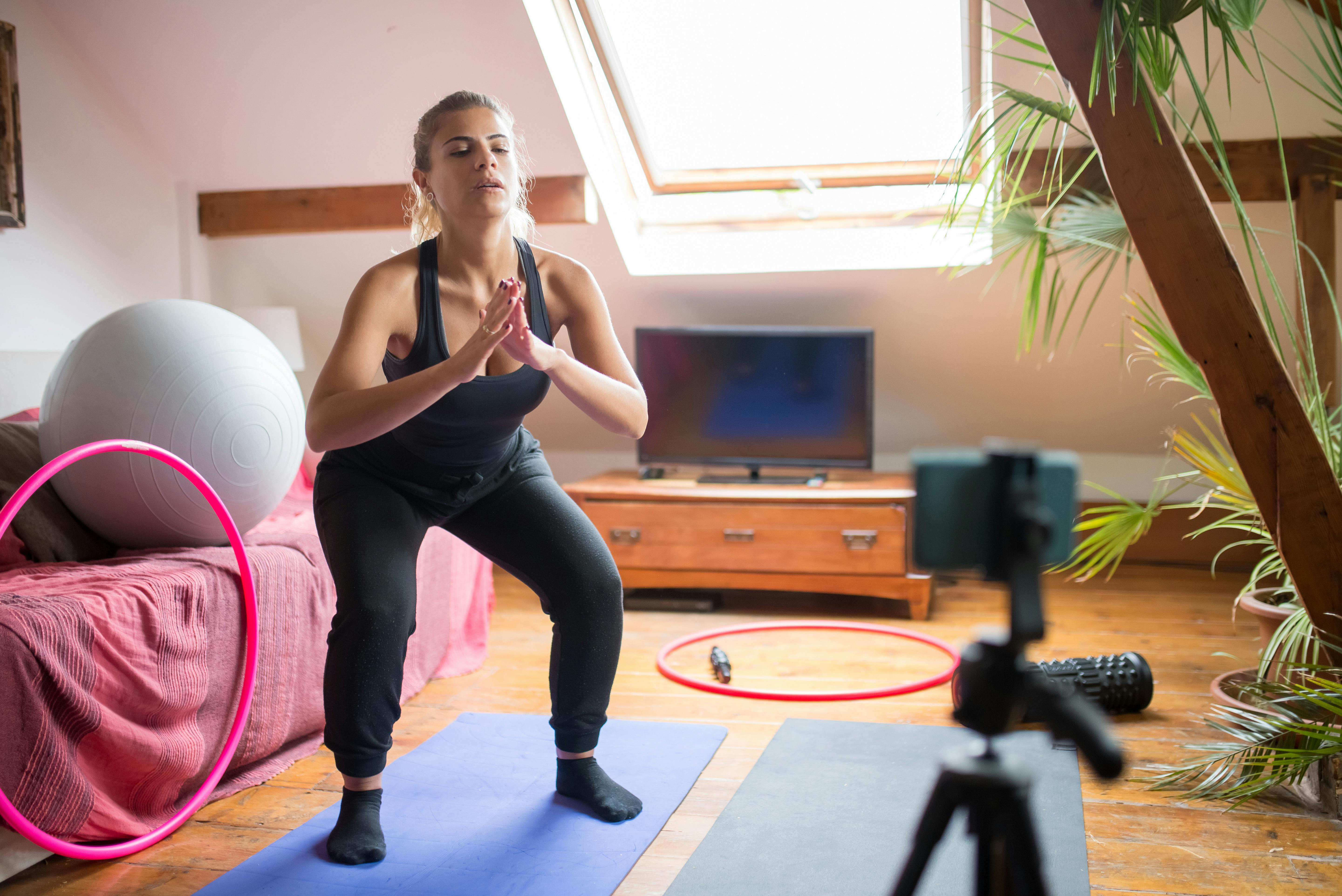
Bodyweight squat
Purpose: Builds lower-body strength (quads, glutes, hamstrings) and supports daily tasks like rising from a chair.
Form cues: Stand shoulder-width, toes slightly out, chest up, core braced. Push hips back and down as if sitting into a chair. Keep knees tracking the line of toes. Drive through heels to stand.
Levels: Level 1: 2 sets × 8–10 reps. Level 2: 3 sets × 12–15. Level 3: 4 sets × 15–20 or tempo squat (3s down, 1s up).
Regression: Sit-to-stand from a chair. Progression: Single-leg squat (assisted) or pistol progression.
Glute bridge
Purpose: Glute activation and hip extension — helps posture and reduces low-back strain.
Form cues: Lie on your back, knees bent, feet hip-width. Press through heels, squeeze glutes at top, avoid over-arching lower back. Pause 1–2 seconds, lower slowly.
Levels: L1: 2 × 10–12; L2: 3 × 15; L3: Single-leg bridge 3 × 8 each side.
Incline push-up / wall push-up
Purpose: Upper-body pressing for chest, shoulders, and triceps.
Form cues: Hands shoulder-width on a wall, bench or sturdy counter. Keep body straight from head to heels. Lower chest to surface, elbows at ~45°, push back to start.
Levels: L1: Wall push-ups 3 × 8–10; L2: Incline at table 3 × 10–12; L3: Floor kneeling → full push-up 3 × 6–12.
Plank (forearm or high)
Purpose: Core stability and endurance.
Form cues: Keep a straight line from head to heels. Avoid hip sag or hiking. Breathe steadily. Engage glutes and quads lightly for stability.
Levels: L1: Knees-down plank 3 × 20–30s; L2: Full forearm plank 3 × 30–45s; L3: 45–60s or add alternating shoulder taps.
Reverse lunge
Purpose: Single-leg strength and balance (quads, glutes).
Form cues: Step back with one leg, drop the back knee to just above the floor, keep torso upright, front knee above ankle. Push through front heel to return.
Levels: L1: 2 × 8 per leg; L2: 3 × 12; L3: Walking lunges or jump lunges.
Step-up (use a stable surface)
Purpose: Lower-body strength with functional carryover to stairs.
Form cues: Place full foot on step, drive through heel to stand, avoid pushing off with trailing leg. Control descent.
Levels: Use a low step for L1 and increase height or speed for L3.
Dead bug
Purpose: Core stability with low spinal load.
Form cues: Lie on back, hips and knees bent 90°. Slowly lower opposite arm and leg while keeping lower back in contact with floor. Return and switch sides.
Levels: L1: One limb at a time; L2: Alternating 3 × 10–12 per side; L3: Add a small pulse or hold at end range.
Bird dog
Purpose: Core and posterior chain coordination and balance.
Form cues: From all-fours, extend opposite arm and leg while keeping hips square and spine neutral. Return slowly.
Mountain climbers (slow to start)
Purpose: Core + light conditioning.
Form cues: Maintain a plank line; drive knees toward chest one at a time at a controlled pace.
Modified burpee (no push-up)
Purpose: Full-body conditioning with lower impact when needed.
Form cues: Squat, step back to plank (or jump back), stand up and reach/mini-jump. Remove jump for lower impact.
Triceps dip (chair edge)
Purpose: Triceps strength and shoulder stability.
Form cues: Hands on chair edge, hips forward, bend elbows to ~90°, push back. Keep elbows close to body.
Y raises (lying)
Purpose: Mid-back and scapular control to balance pressing work.
Form cues: Lie face down, lift arms in a Y shape with thumbs up, squeeze shoulder blades together. Keep neck neutral.
Hip hinge / Good morning (bodyweight)
Purpose: Posterior chain strength and hip mobility.
Form cues: Soft knee bend, push hips back while keeping spine neutral, feel stretch in hamstrings, return to standing by driving hips forward.
Single-leg Romanian deadlift (bodyweight)
Purpose: Balance, posterior chain, and unilateral strength.
Form cues: Slight knee bend, hinge at hips, reach forward with torso while raising opposite leg. Keep hips square and core engaged.
Standing calf raise
Purpose: Ankle strength and stability.
Form cues: Rise onto toes slowly, control descent. Perform double-leg then single-leg for progression.
Curtsy lunge
Purpose: Glute medius activation and lateral stability.
Form cues: Step one leg behind and across the other, bend both knees into a curtsy. Keep chest tall.
Cossack squat (partial)
Purpose: Lateral strength and mobility. Keep it partial for beginners.
Reverse plank
Purpose: Posterior chain and shoulder stability.
Child's pose, cat-cow, world's greatest stretch
Purpose: Mobility sequences for recovery and flexibility.
Additional variations and alternatives are included later as part of progressions and sample workouts.
30+ ready beginner workouts (organized by time and goal)
Below are many ready-to-use sessions. Choose by time available and goal (strength, cardio, mobility, mixed). Start with 2–4 sessions per week and combine with daily walking or active movement.
10-minute express (daily habit starter)
Warm-up 1–2 min marching. AMRAP 8 minutes:
- 10 bodyweight squats
- 8 incline push-ups
- 10 glute bridges
Cool-down 1–2 min stretch.
15–20 minute full-body (beginner)
- Warm-up 5 min
- 2 rounds: Squats 12, Incline push-ups 10, Dead bug 12 per side, Glute bridge 15, Plank 30s
- Cool-down 4 min
20–30 minute lower-body focus
- Warm-up 5–8 min
- 3 sets: Reverse lunge 10 per leg, Step-up 10 per leg, Wall sit 45s, Calf raises 20
- Cool-down 5 min
20–30 minute upper-body & core
- Warm-up 5 min
- 3 rounds: Incline push-ups 12, Triceps dips 12, Y-raises 15, Plank shoulder taps 20 (10 per side)
- Cool-down 5 min
Low-impact cardio (20 min)
- Warm-up 5 min
- Intervals: 5 rounds of 2 min brisk marching + 1 min light movement (step-touch or side shuffle)
- Cool-down 3–5 min
Mobility & recovery session (20 min)
- Dynamic mobility flow: World's greatest stretch, hip circles, cat-cow (10 min)
- Gentle yoga: child pose, pigeon variation, hamstring hold (10 min)
Each of these can be repeated, combined, and progressed across the 12-week plan below.
12-Week progressive plan (detailed)
This section provides a week-by-week progression to take an absolute beginner to a confident, regular exerciser. Aim to complete the plan over 12 weeks, but move at your own pace. Rest and recovery are part of training — listen to your body.
Principles
- Consistency first: it's better to train 3x/week consistently than 6x/week inconsistently.
- Progressive overload: add reps, sets, or reduce rest every 1–3 weeks.
- Deload: take a lighter week (reduce volume by ~30%) every 4th week if you're feeling very fatigued.
Weeks 1–4: Habit and form (foundation)
Goal: Build habit, learn technique, and reduce fear of movement.
Schedule (example): 3 sessions/week: Monday (Full-body), Wednesday (Mobility + light cardio), Friday (Full-body).
Session content: Use Level 1 rep schemes. Focus on form and tempo. Keep RPE 4–6/10.
Weeks 5–8: Volume & confidence
Goal: Increase total work and build cardiovascular base.
Progressions: add an extra set to main strength moves, increase plank holds by 10–20s, add a 10-minute interval session once per week. RPE 5–7/10.
Weeks 9–12: Intensity & skill
Goal: Introduce harder progressions (single-leg work, full push-ups) and reduce rest to improve endurance.
Progressions: Tempo changes (3s eccentric), supersets, single-leg bridges, higher-rep circuits. RPE 6–8/10 for challenging sets.
Sample 12-week microcycle (example week at week 8)
- Monday — Strength: 3x (Squat 12, Incline push-up 10, Glute bridge 15, Plank 40s)
- Tuesday — Active recovery: 30–40 min brisk walk + mobility 10 min
- Wednesday — Conditioning: 20 min interval (30s work/30s rest) of mountain climbers, step-ups, bodyweight squats
- Thursday — Mobility & light core (20 min)
- Friday — Strength: 3x (Reverse lunge 10/leg, Triceps dips 12, Dead bug 12/side, Calf raises 20)
- Saturday — Optional light activity: dance, walk, or rest
- Sunday — Rest
Use the app for tracking and reminders if you prefer guided sessions: Slim & Strong.
Nutrition basics to support training
Nutrition helps recovery, supports energy for workouts, and drives body composition changes. Below are practical, evidence-based rules for beginners.
Protein
Aim for roughly 1.0–1.6 g/kg bodyweight/day if you're trying to build strength or preserve muscle while losing weight. For general health, 0.8 g/kg/day is a reasonable baseline. Spread protein evenly across meals where possible.
Energy balance
If fat loss is the goal, a modest calorie deficit (e.g., 200–500 kcal/day) while keeping protein adequate and maintaining resistance training is effective. For muscle gain, aim for a slight calorie surplus and progressive overload.
Hydration and micronutrients
Drink water throughout the day, more around workouts. Prioritize vegetables, whole grains, legumes, lean proteins, and healthy fats to cover vitamins and minerals. If you have specific deficiencies, consult a registered dietitian for personalized advice.
Pre- and post-workout snacks
- Pre-workout (1–2 hours): banana with peanut butter, yogurt with fruit, or a small sandwich
- Post-workout (within 2 hours): protein source + carbohydrate — e.g., eggs and toast, smoothie with protein powder and fruit, or beans and rice
Staying consistent & motivation hacks
Consistency beats intensity for beginners. Small daily habits become results over months. Here are practical strategies proven to help build exercise routines.
- Schedule it: Put workouts in your calendar like appointments.
- Habit stacking: Attach a workout to an existing habit (e.g., after morning coffee).
- Start tiny: Commit to 5–10 minutes on days you feel busy — often you do more once started.
- Track progress: Use a notebook or an app to log workouts and celebrate small wins.
- Accountability: Find a friend, join a group, or use social sharing.
Using a guided app can increase adherence—our Slim & Strong app includes beginner programs, timers, and streak tracking: Download Slim & Strong.
Troubleshooting common beginner problems
Excessive muscle soreness (DOMS)
Mild to moderate soreness after starting is normal. Manage with light activity, hydration, sleep, and gentle stretching. If soreness prevents daily function or lasts more than 7–10 days, reduce intensity and consult a clinician if severe.
No visible progress
Check these factors: consistency, progressive overload (are you increasing reps/sets?), sleep quality, nutrition, and stress. Progress may be slow but measurable — track objective metrics like plank hold time, number of squats, or how you feel climbing stairs.
Joint pain or discomfort
Reassess form, reduce range of motion, and use regressions (e.g., chair squats instead of deep squats). If pain is sharp or persistent, consult a health professional.
Pregnancy & post-partum guidance
Many women can safely continue or begin low to moderate intensity exercise during pregnancy, but individual risks vary. Key points:
- Get medical clearance before starting or progressing intensity if pregnant or postpartum.
- Avoid exercises that cause dizziness, breathlessness at rest, or pain.
- Modify supine positions after the first trimester by propping the upper body or exercising on the side to avoid aortocaval compression.
- Focus on pelvic floor health and gradually reintroduce abdominal loading post-partum after clearance by your provider.
For pregnancy-specific recommendations, consult national guidelines and your maternity care provider.
Frequently asked questions (short answers)
Can I get strong with bodyweight only?
Yes. Progressive bodyweight training builds strength for beginners and many intermediate trainees. Use unilateral moves, tempo changes, and reduced rest to continue challenging your muscles.
How often should I train?
Start with 3 sessions per week and increase to 4–5 as fitness improves. Include at least two muscle-strengthening sessions weekly.
Is walking enough?
Walking is excellent for aerobic health but combine it with strength sessions twice a week for balanced benefits.
What if I have limited space?
Most exercises require a small footprint (approx. 2m × 2m). Use bodyweight variations and step-ups on a stable stair or low stool.
Printable checklist & templates
Use this short checklist before, during, and after each session.
- Before: Warm-up completed (5–8min), space cleared, water ready.
- During: Form-first, breathe, stop for sharp pain.
- After: Cool-down, stretch, log workout.
Template workout (copy/paste for tracking):
Date: Workout: Warm-up: Main sets: Total time: How I felt (1–10): Notes:
References & evidence (key sources)
The guidance in this article is built from authoritative sources and peer-reviewed literature. For practical public-health recommendations, consult the World Health Organization (WHO), American College of Sports Medicine (ACSM), and Centers for Disease Control and Prevention (CDC). Selected evidence used while drafting:
- World Health Organization — Physical Activity Guidelines (WHO).
- American College of Sports Medicine — Physical Activity and Resistance Training Guidelines.
- Centers for Disease Control and Prevention — Physical Activity Basics.
- Peer-reviewed trials and systematic reviews on home-based and bodyweight training effectiveness.
- Harvard Health Publishing — Benefits of exercise on mental and physical health.
Get the app to follow guided sessions and track progress: Slim & Strong — Download on Google Play.
Comments
Post a Comment
We love your feedback! Please share your thoughts below. All comments are moderated to ensure a positive and helpful community. Spam or inappropriate comments will be removed.